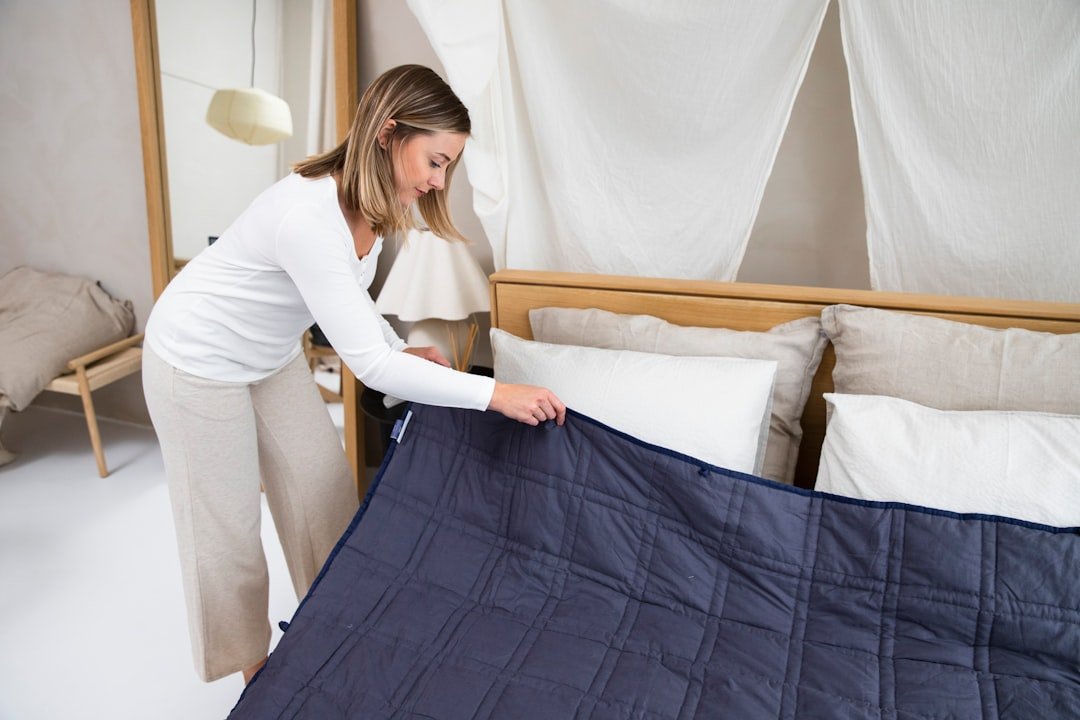
A common misconception is that the heaviest weighted blanket is automatically the best weighted blanket for anxiety and better sleep. It is not. The best weighted blanket for anxiety and better sleep is usually one that feels gently grounding while you can still move, regulate your temperature, and sleep in your usual position without fighting the fabric. A blanket that feels too heavy may become another sleep distraction.
Weighted blankets use deep, even pressure across the body, often through glass beads or similar fill sewn into small pockets. Some adults find that sensation calming during a wind-down routine, particularly when they are reading, resting, or settling into bed. Results are personal. A blanket is a comfort tool, not a treatment for anxiety or insomnia, and it will not suit every sleeper.
My practical starting point is comfort first. If you dread pulling it over yourself, it is not the right weight or construction for you. A good purchase should make your bedtime setup simpler, not turn it into another thing to troubleshoot at 2 a.m.
Best weighted blanket for anxiety and better sleep buying guide
Begin with the question that product listings often bury: when will you use it? A blanket for a 20-minute evening reset can be heavier or warmer than one you plan to keep on the bed all night. This distinction matters. People who sleep hot, change positions often, or share a bed generally need a more adaptable option than someone using a throw while sitting on the sofa.
A commonly used rule of thumb is to start near 8 to 12 percent of an adult’s body weight, but it is a starting range rather than a rule. The familiar 10 percent guideline is a general convention for narrowing a crowded product category, yet your build, mobility, heat sensitivity, and sleep habits matter more than landing on a mathematically perfect number. Lighter is often easier to live with.
For example, a 150-pound adult might research blankets in the 12- to 15-pound range. If that person sleeps warm, has shoulder discomfort, or mainly wants a blanket for long overnight use, beginning at 12 pounds may be more sensible than automatically choosing 15. If the first few minutes feel restrictive, stop there. Do not assume you need to “get used to” discomfort.
Choose a weight you can move easily
A weighted blanket should feel easy to remove without assistance. That is the basic safety and comfort test. You should be able to shift it off your legs, sit up, and change sides in bed with normal effort while tired and half awake.
Pay attention to how weight is distributed, not only the number printed on the label. A 15-pound blanket with small, evenly stitched compartments can feel calmer and less lumpy than another 15-pound blanket with large pockets that let the fill collect at the edges. Glass beads are common because they add weight without huge bulk, though the quality of the stitching and internal baffles has a major effect on whether the blanket stays balanced over time.
Be cautious with a blanket that is very large for one person. More fabric does not automatically mean more comfort. A heavy king-size blanket can pull toward the floor, create uneven pressure, and make it awkward for a smaller sleeper to reposition. For many people, a single-person size is the more practical choice even on a larger mattress.
If you share a bed, individual blankets are usually easier. Each sleeper can choose their own weight and temperature level. This also avoids the nightly tug-of-war that happens when a heavy shared blanket slides toward the person who moves more.
Match the fabric to your sleep temperature
Heat is one of the biggest trade-offs. A weighted blanket may feel soothing at first, then become uncomfortable if it traps warmth after you fall asleep. Fabric changes the experience a great deal.
Cotton covers are familiar, generally breathable, and easy to pair with typical bedding. They can be a sensible middle ground for year-round use, though a thick cotton construction can still feel warm once bead fill and multiple layers are added. Look beyond words like “cooling.” Check the stated materials, cover design, and care instructions.
Bamboo-derived rayon, lyocell, and similar smooth plant-based fabrics are often marketed to warm sleepers because they can feel cooler against the skin. They may need gentler laundering, however. A fabric that feels lovely but requires difficult care can be frustrating if you need to wash it often.
Minky, plush polyester, fleece, and sherpa-style covers feel soft and cozy. They are usually better suited to cold rooms, lounging, or people who know they like warmth. They can be too insulating for many overnight sleepers. Soft is not always cool.
Some blankets have a removable duvet-style cover, while others are one integrated piece. A removable cover adds a step when making the bed, but it can make routine washing far easier and lets you change the feel by season. An integrated blanket is simpler in theory, yet a heavy item that needs spot cleaning or commercial-machine washing may be less convenient in real life.
Look closely at size and construction
Measure your intended use, not just your mattress. A weighted blanket is normally meant to cover the person, rather than hang over every side of the bed like a traditional comforter. That smaller footprint helps prevent the weight from dragging down or slipping off during the night.
For solo use, check both the dimensions and the stated recommended body size. A blanket that is too narrow can leave you adjusting it repeatedly, while one that is excessively wide may bunch around your arms. Small details count. Consider whether you sleep curled on your side, flat on your back, or with one foot outside the covers.
Construction also affects noise. Glass-bead blankets can make a light rustle when moved, which may not bother you at all, but sensitive sleepers may prefer a design with denser internal quilting and less shifting fill. Product reviews can help identify recurring issues such as bead leakage, torn seams, loose threads, or corners that bunch after washing. Read the lower-rated reviews too.
Look for tightly sewn square or diamond compartments and reinforced perimeter stitching. This does not guarantee durability, but it is a more useful clue than an attractive color name. If a listing does not clearly explain fill, outer fabric, weight, dimensions, and washing method, I would move on.
Think about washing before you buy
A weighted blanket is harder to clean than an ordinary throw. This is easy to overlook. Even a moderate-weight blanket may exceed the safe capacity of a small home washing machine once it absorbs water.
Check the manufacturer’s current care label before ordering, especially if you have pets, allergies, night sweats, or children in the home. Some products are machine washable in a large-capacity machine, some recommend hand washing or spot cleaning, and some have washable covers with an inner blanket that needs limited cleaning. Prices and care policies vary by region, so verify the details on the official product page.
A removable, machine-washable cover is often the lower-maintenance choice. Buy a spare cover only if you know you will use it, since extra accessories can make a seemingly affordable blanket more expensive. Also consider drying time. A blanket that stays damp for a full day may not fit a busy weekly laundry routine.
Set a realistic budget
Price can reflect fabric, stitch quality, cover design, certification claims, return terms, and brand markup. It does not reliably tell you whether a blanket will feel calming on your body. Start with your non-negotiables instead.
A lower-priced blanket can be perfectly reasonable if it has clear material information, even weight distribution, a sensible return policy, and a washable cover or manageable care plan. Higher-priced options may offer more fabric choices, better cover systems, or longer warranties, but no feature can promise better sleep. Be skeptical of certainty.
Before checkout, compare the full cost: blanket, cover, shipping, taxes, and any return fee. Weighted products can be expensive to ship back because of their weight. A generous-looking trial period is less useful if the return process requires paying substantial postage or keeping bulky original packaging.
I would prioritize a return policy over decorative extras. A weighted blanket is unusually personal, and the feeling cannot be judged from product photos alone. Read the conditions carefully, including whether washed items can be returned and whether the company provides a prepaid label.
Know when a weighted blanket is not a good fit
Do not use a weighted blanket for an infant or young child unless you have received individualized guidance from an appropriate qualified professional. This is not a casual baby-sleep accessory. Children, older adults, and anyone unable to remove the blanket independently need special consideration.
Adults should also pause before buying if they have mobility limitations, breathing concerns, circulation issues, chronic pain that makes pressure uncomfortable, or sensory sensitivities that can become distressing. Ask a qualified healthcare professional for individualized advice when any medical condition, sleep disorder, or mental health concern is involved. General product guidance cannot assess personal risk.
Claustrophobia is another practical consideration. Some people love pressure on their legs but dislike weight over the chest or shoulders. If that sounds familiar, a weighted lap blanket for seated relaxation may feel less intense than a full-bed blanket. There is no prize for tolerating an uncomfortable setup.
Use it as part of a wind-down ritual
A blanket works best when it has a clear role. Try it during the final 15 to 30 minutes before bed while you do one quiet activity, such as reading a few pages or listening to a familiar low-key audio track. Keep lights low. Give your body a consistent cue that the day is slowing down.
Here is a simple test routine: use the blanket for three evenings, note whether you feel too warm or restricted, then adjust one variable rather than changing everything at once. Try a lighter pajama layer, use it over your legs instead of your whole body, or switch it to a sofa ritual. A few notes in your phone can reveal a pattern more clearly than a vague first impression.
If you wake up hot, tangled, or irritated, treat that as useful information. You may prefer a lighter weight, a cooler cover, or a shorter period of use before sleep. The right choice is the one you can use comfortably and safely, not the one with the most dramatic marketing language.
A practical final checklist
Before you buy, confirm that you can remove the blanket independently, the selected weight feels reasonable for your body, and the size is meant for one sleeper if you are not sharing it. Check the fabric and care label. Then read the return conditions.
- Choose a weight that feels manageable, using the commonly suggested 8 to 12 percent range only as a general rule of thumb.
- Pick breathable materials if you already sleep warm.
- Favor even stitching, clear fill details, and a size that will not drag off the mattress.
- Check whether your washing machine can safely handle the blanket or whether a removable cover makes more sense.
- Skip any product that feels difficult to remove, overly hot, or restrictive.
The best weighted blanket for anxiety and better sleep is not necessarily the heaviest, softest, or most expensive option. It is the one that fits your physical comfort, cleaning routine, and bedtime habits without creating new problems. Start conservatively. Comfort is the point.
Related posts
This article is for general informational purposes only and does not constitute medical or mental health advice. Self-care and mindfulness practices affect everyone differently — always consult a qualified professional for anxiety, sleep, mood, or any ongoing mental health concern.
Disclosure: This post may contain affiliate links. If you click through and make a purchase, we may earn a commission at no extra cost to you. We only recommend products we’ve researched or genuinely believe in.